
If you’ve just finished your 12th and you’re sitting with a calculator, a college brochure, and a hundred questions in your head you’re not alone. Every year, thousands of girls across Punjab face the same dilemma: should I wait for a low-fee government nursing seat, or pay more at a private college and start my career on time?
It’s a fair question. Nursing is one of the few career paths today that offers job security, respect, and the chance to work anywhere in the world but only if you actually get in, get trained well, and get placed. That’s where the real comparison begins. Because “cheaper” doesn’t always mean “better value” and “expensive” doesn’t always mean “worth it.” Let’s break it down honestly, the way a counsellor would explain it to her own daughter.
Why This Decision Feels So Confusing
After 12th, most families compare nursing colleges purely on fee structure. Government college fees look attractive on paper. But very few people talk about the real cost of a nursing education which includes far more than tuition. It includes:
- Whether you actually get a confirmed seat
- How long you wait to start (and how many years you may lose)
- The quality of clinical/hospital training you receive
- Whether the college helps you get placed after the course
- Whether your degree or diploma is recognised by INC, PNRC, and BFUHS
Once you factor in these points, the “cheaper” option can quietly become the more expensive one in time, opportunity, and peace of mind.
Guaranteed Seat vs Waiting List: The Cost Nobody Talks About
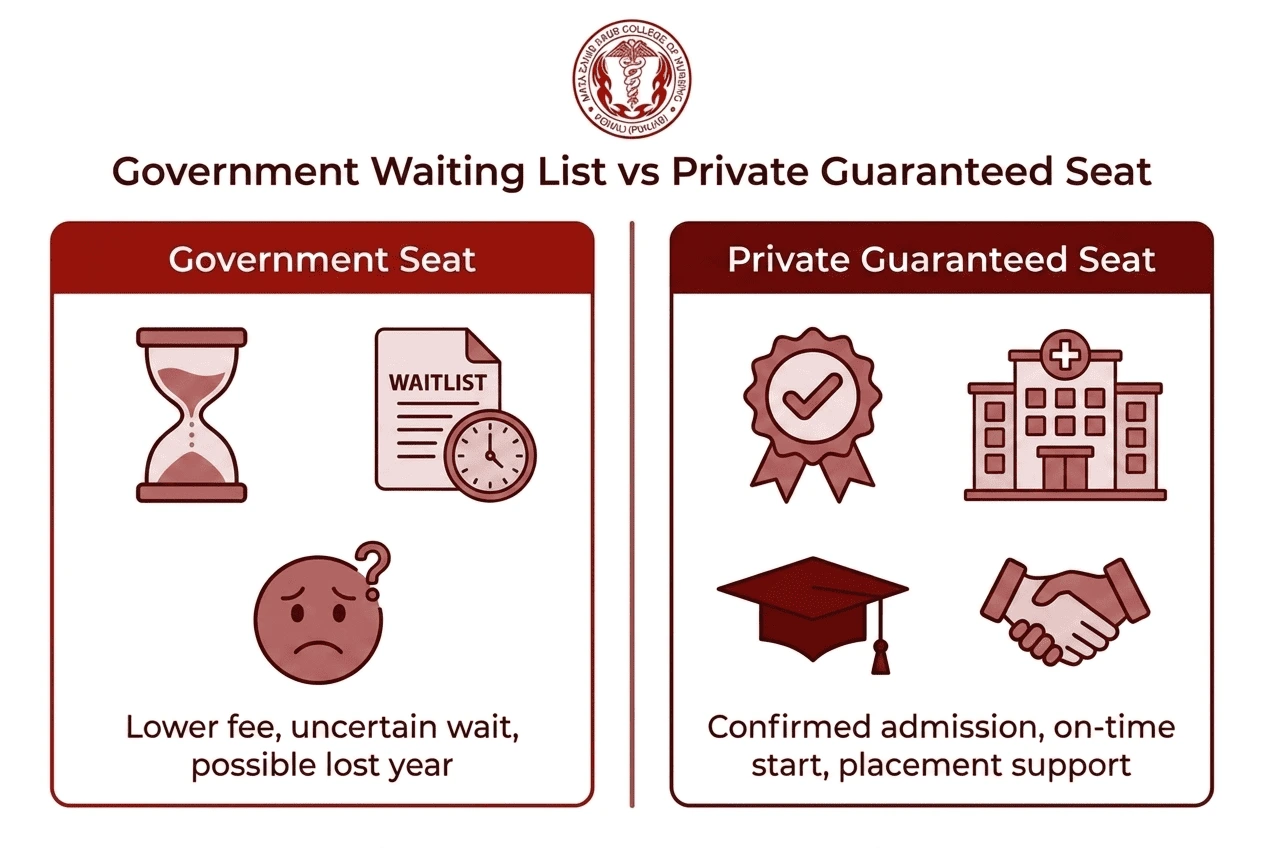
Government and PNRC-counselling seats for GNM and ANM are limited. Every year, lakhs of girls apply for a small number of seats through the state counselling process. Even meritorious students often land on a waiting list not because they aren’t capable, but simply because the seats run out.
Here’s what a waiting list actually costs a student:
- A lost academic year if the seat doesn’t come through in time
- Re-appearing for counselling the following year, with fresh forms, fresh deadlines, and no guarantee either
- Falling behind friends and batchmates who are already a year into clinical training
- Emotional stress of uncertainty during a time that should be about building a career, not waiting for luck
A private, PNRC-approved nursing college works differently. Once you meet the eligibility criteria, admission is direct, no waiting list, no lottery. You know your seat is confirmed, your batch starts on time, and your four (or three, or two) years begin immediately. For many families, this certainty alone is worth the difference in fees.
Nursing College ROI : What You’re Actually Paying For
Return on investment isn’t just about the size of your first salary, it’s about how fast you start earning, how well-trained you are, and how many doors your qualification opens.
A private nursing college that invests in real infrastructure typically offers:
- Full clinical exposure in partner hospitals from an early stage of the course
- Smaller batch sizes, meaning more hands-on practice instead of just watching from the back of a crowded ward
- Skill labs for practising procedures safely before working on real patients
- Faculty attention that a heavily overcrowded, under-resourced institution may not be able to give every student
- A start date this year, not “maybe next year”
When you compare the extra fee against one full year of lost time, lost income potential, and a repeated application cycle, the “expensive” private option often works out cheaper in real terms because a year of your career is worth far more than the fee difference.
Private College Placement Support: The Part That Actually Pays You Back
This is where cost-vs-value becomes very real. A government seat gets you a qualification. It does not automatically get you a job. After GNM, B.Sc. Nursing, or M.Sc. Nursing, the next big question is: who is going to help me get placed?
Established private nursing colleges with a long track record decades of alumni working in hospitals across India and abroad usually build direct placement relationships with hospitals. That means:
- Campus interviews instead of cold-applying to hundreds of hospitals on your own
- Guidance on resume building, interview preparation, and documentation
- A trusted alumni network that current students can lean on
- A known, recognisable college name that hospital HR departments already trust
This is value that doesn’t show up on a fee receipt, but it’s often the single biggest factor in how quickly a fresh nursing graduate starts earning.
The Real “Lost Year” Cost of Reapplying
Let’s put real numbers on this, conceptually. Say a government-seat aspirant doesn’t clear the waiting list this year. She reapplies next year. That’s:
- One year of tuition-equivalent income she didn’t earn
- One year older when she starts her career, compared to a batchmate who joined a private college directly
- One more year of counselling stress, entrance preparation, and uncertainty for the family
- A full year’s delay in supporting the household which, for many nursing aspirants, is one of the biggest reasons they chose this career in the first place
When you calculate the “fee saved” by waiting for a government seat against the “income and time lost” by not getting one, the private college fee gap often shrinks dramatically, sometimes disappearing altogether.
So, Is a Private Nursing College Worth the Fees?
The honest answer: it depends on which private college. Not every private institution offers strong value, some genuinely are just expensive with little to show for it. The fee is worth paying when the college offers:
- Recognised approval INC, BFUHS affiliation, and PNRC registration, so your degree/diploma is valid anywhere in India
- A guaranteed seat, not a waiting-list gamble
- Real clinical training in genuine hospital settings, not just classroom theory
- Placement support, not just a certificate at the end
- A proven track record an established college with years of graduates already working successfully
This is exactly the standard families should hold every nursing college to before comparing fees to private or government.
Where Mata Sahib Kaur College of Nursing Fits In
Mata Sahib Kaur College of Nursing, Mohali (MSKCON), has been training young women for nursing careers for over 25 years, with more than 10,000 graduates now working in hospitals across India and abroad. It is recognised by the Indian Nursing Council (INC), affiliated with Baba Farid University of Health Sciences (BFUHS), and registered with the Punjab Nurses Registration Council (PNRC) the three approvals every nursing aspirant and parent should verify before paying any fee, anywhere.
At MSK College, admission is direct once eligibility is met no uncertainty of a PNRC waiting list so a confirmed seat means the academic year starts on schedule, hostel accommodation is available for outstation students, and clinical training happens in real hospital settings from early in the course. The college’s placement support and long-standing hospital network are built on 25+ years of relationships, which is part of what “private college placement support” should actually mean.
If you’re comparing fees across colleges, don’t just compare the number on the fee receipt compare what happens after you pay it.
Which Course Should You Apply For?
The right course and the exam relevance depends on your academic background:
- GNM (General Nursing & Midwifery) – 3 years: For 10+2 in any stream with minimum 45% aggregate (relaxable for SC/ST candidates). No separate entrance exam — admission is through PNRC-regulated merit and counselling norms. This is one of the fastest, most accessible routes into a nursing career.
- ANM (Auxiliary Nurse Midwifery) – 2 years: For 10+2 in any stream, for female candidates aged 17–30. Also governed by PNRC norms, no separate entrance test.
- B.Sc. Nursing (Basic) – 4 years: Requires 10+2 with Medical (Physics, Chemistry, Biology) and admission through the entrance test conducted by Baba Farid University of Health Sciences (BFUHS), Faridkot.
- B.Sc. Nursing (Post Basic) – 2 years: For GNM-qualified candidates, through the BFUHS entrance test.
- M.Sc. Nursing – 2 years: For B.Sc. Nursing graduates with 1 year of experience, through the BFUHS entrance test, with specialisations available in Medical-Surgical, Obstetric & Gynaecological, Community Health, Child Health, and Mental Health Nursing.
Knowing which exam route applies to your qualification is the first step to comparing colleges accurately since a government BFUHS-entrance seat and a PNRC-counselling seat follow completely different timelines and competition levels.
Admission Process at MSK College of Nursing, Mohali
- Check your eligibility for the course you want (age, qualification, and marks as listed above).
- Fill the admission enquiry / application form available on the college website or at the campus, Chandigarh-Kharar Highway, Mohali.
- Submit required documents 10th and 12th mark sheets, ID proof, category certificate (if applicable), and passport-size photographs.
- Appear for the entrance test (if applicable) B.Sc. Nursing, Post Basic B.Sc., and M.Sc. candidates must qualify the BFUHS entrance test; GNM and ANM admissions follow PNRC merit norms.
- Complete counselling/verification at the college as per PNRC/BFUHS guidelines.
- Confirm your seat by completing fee formalities and document verification.
- Begin classes with orientation, hostel allotment (if required), and induction into clinical training.
Because admissions are opening soon, students are advised to apply early — direct, PNRC-approved private admission means your seat isn’t dependent on a waiting list clearing in time.
A nursing career is one of the most secure, respected, and globally portable paths a young woman can choose today. The real question was never “government vs private” it’s “which college gives me a guaranteed seat, real training, and a genuine path to employment for what I’m paying.” When you calculate the full cost including lost time, lost income, and lost opportunity from a waiting list a well-established, fully recognised private nursing college often turns out to be the smarter investment, not just the more expensive one.
If you’re ready to stop waiting and start your nursing career on schedule, MSK College of Nursing, Mohali is currently accepting admission enquiries for the upcoming session.
FAQs
Q1. Is it worth paying more for a private nursing college instead of waiting for a government seat?
Often yes because a confirmed private seat avoids the risk of a full year lost on a government waiting list, and a recognised private college also offers placement support that a fee receipt alone doesn’t show.
Q2. What is the difference between a guaranteed seat and a waiting list in nursing admissions?
A guaranteed seat means your admission is confirmed once you meet eligibility, so your course starts on time. A waiting list means you may or may not get a seat, depending on how many admitted candidates withdraw and there’s no fixed timeline for that.
Q3. Do I need to give an entrance exam for nursing courses after 12th?
It depends on the course. GNM and ANM admissions follow PNRC eligibility and counselling norms with no separate entrance exam. B.Sc. Nursing, Post Basic B.Sc., and M.Sc. Nursing require qualifying the entrance test conducted by Baba Farid University of Health Sciences (BFUHS).
Q4. How do I know if a private nursing college is genuine and recognised?
Check for three approvals: registration with the Indian Nursing Council (INC), affiliation with a recognised university such as Baba Farid University of Health Sciences (BFUHS), and registration with the state nursing council in Punjab, the Punjab Nurses Registration Council (PNRC).
Q5. Does a private nursing college help with job placement after the course?
Established private colleges with a long track record typically maintain placement support and hospital tie-ups built over years of alumni relationships, which can make it easier to get placed compared to figuring it out alone after graduation.