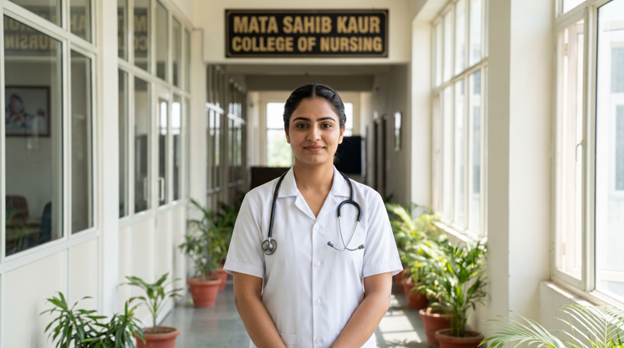
You cleared PPMET. Now comes the harder decision: choosing the right nursing college. Many students assume a government nursing college is automatically the best option, mainly because of lower fees. The honest answer is that neither type is universally better. The right college depends on your PPMET rank, your domicile status, and how you weigh fees against hospital training quality and student support. This guide, written by the faculty team at Mata Sahib Kaur College of Nursing, lays out a neutral framework so you can evaluate any college on your BFUHS list, government or private, using the same criteria.
Government vs Private Nursing Colleges: Quick Comparison
| Factor | Government Nursing Colleges | Private Nursing Colleges |
| Tuition fee per year (approximate) | ₹40,000 to ₹1,00,000 | ₹1,00,000 to ₹2,50,000, varies by college |
| Share of total PPMET seats | Small fraction of total seats | Majority of total seats |
| Domicile requirement | Usually restricted to Punjab domicile candidates | Generally open to candidates from other states |
| Clinical hospital type | Typically one government teaching hospital | Varies; some have tie-ups with both government and private hospitals |
| Degree validity and registration | INC, BFUHS, PNRC | INC, BFUHS, PNRC |
Government nursing seats in Punjab are usually reserved for domicile candidates and form a small share of total PPMET seats. For most students filling a BFUHS choice list, the practical decision ends up being between private colleges rather than between government and private as equal options.
A Government Nursing College May Be the Better Choice If
- You qualify for a government seat under the domicile and category rules.
- Keeping tuition cost as low as possible is your main priority.
- You want training concentrated in one large public teaching hospital.
- You are comfortable with a single-site clinical training model rather than rotating across multiple hospitals.
A Private Nursing College May Be the Better Choice If
- You did not qualify for, or did not get, a government seat.
- You want clinical exposure across more than one type of hospital.
- You are comparing colleges specifically on hostel facilities, security, and student support.
- You want to evaluate placement outcomes and career pathways as part of your decision.
If you are specifically researching private nursing colleges in Punjab, the checklist in the next section applies regardless of which institution you are evaluating.
Does More Patient Volume Mean Better Training?
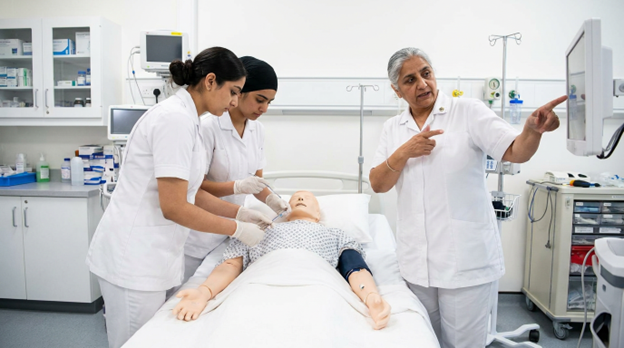
Government nursing colleges are attached to large public hospitals that treat a high number of patients every day, so students see more cases. This is a real strength of government colleges, and it should not be dismissed. But seeing hundreds of patients does not automatically make a better nurse. Students learn faster when someone experienced is actually watching their technique and correcting mistakes in real time. A ward with very high patient numbers and very few staff to supervise a large batch of students gives volume, but not always close supervision. This applies to both government and private colleges. The relevant question for any college is not how many patients its attached hospital sees, but how closely students are supervised while they are there.
A Framework for Comparing Any College on Your List
Use this checklist for every college name on your BFUHS list, government or private, instead of relying on reputation or word of mouth.
| Factor | Why It Matters | How to Verify It |
| INC Approval | Determines whether your degree is recognised | Check the college’s name on the Indian Nursing Council website |
| BFUHS Affiliation | Confirms the college is authorised to award the degree | Confirm on bfuhs.ac.in |
| PNRC Registration Eligibility | Required to legally practise as a nurse in Punjab | Confirm through the Punjab Nurses Registration Council |
| Hospital Tie-Ups | Decides the range and quality of clinical exposure | Ask the college directly which hospitals it uses, and for how many weeks per posting |
| Simulation Lab | Lets students practise procedures before working on real patients | Ask to see the lab during a campus visit, not just photos |
| Hostel Facilities | Affects day-to-day safety and living conditions | Visit in person if possible, and ask about warden supervision and visiting hours |
| Placement Outcomes | Affects job prospects after graduation | Ask for names of hospitals that hired recent graduates, not just a placement percentage |
| Faculty Qualifications | Affects the quality of classroom teaching | Ask for the faculty-to-student ratio and faculty qualifications |
Treat any claim a college makes about itself, including this one, as a starting point to verify rather than a final answer. A college that is willing to give specific, checkable details such as named hospitals and a faculty-to-student ratio is generally more trustworthy than one that uses only general descriptions like “excellent facilities” or “best in the region.”
What a Mixed Hospital Network Can Look Like: Mata Sahib Kaur College of Nursing
Hospital tie-ups vary significantly between colleges, including among private colleges, so this is worth checking individually rather than assuming all private colleges offer the same training. As one verifiable example, Mata Sahib Kaur College of Nursing (MSKCN) in Mohali lists clinical training tie-ups with government hospitals, including Civil Hospital Mohali and Rajindra Hospital Patiala, alongside private hospitals including Cosmo Hospital and Indus Hospital. According to a third-party college profile on Careers360, the institution has an enrolment of around 549 students and a faculty of about 65. When evaluating any college, including this one, the same checklist above applies: ask for current figures directly from the college and confirm hospital tie-ups are still active for the year you would be training.
What Can You Do After BSc Nursing?

A BSc Nursing degree opens several career paths, not just one job title.
- Staff Nurse in government or private hospitals
- ICU or specialised ward nurse, after gaining experience or further certification
- Government nursing jobs, through exams such as state nursing recruitment boards and NORCET for AIIMS and central government hospitals
- Military nursing service, through the Indian Army, Navy, or Air Force nursing cadres
- International opportunities, including pathways to the UK through OSCE-based registration, and roles in the Middle East and Australia, which typically require an additional country-specific licensing exam
- Higher studies, such as MSc Nursing, leading to teaching, specialised clinical, or administrative roles
Which of these paths are realistically open to you depends more on the quality of clinical supervision you receive during your BSc than on whether your college was government or private.
Frequently Asked Questions
Which nursing college is best after PPMET?
There is no single best college for every student. The right choice depends on your PPMET rank, whether you qualify for a government seat, your budget, and how much weight you give to hospital variety, hostel facilities, and placement support. Use the verification framework above for every college on your BFUHS list individually.
Is government nursing always better than private nursing?
Not always. Government colleges generally offer lower fees and high patient volume in a single large hospital. Private colleges vary widely; some offer tie-ups with both government and private hospitals and more structured student support, while others do not. Quality depends on the specific college, not the government-or-private label alone.
Can private nursing college students get government jobs?
Yes. Eligibility for government nursing roles, such as state recruitment exams or NORCET, depends on holding a valid INC-approved, BFUHS-affiliated degree and PNRC registration, not on whether the college itself was government or private.
Which nursing colleges in Punjab provide government hospital training?
Several private colleges in Punjab have tie-ups with government hospitals for clinical postings in addition to private hospitals. Always confirm directly with the specific college which government hospitals are currently included in its clinical training network, since tie-ups can change.
Can I work abroad after BSc Nursing in Punjab?
Yes, this is possible, though it usually requires clearing an additional country-specific licensing exam after graduation, such as the OSCE for the UK. The quality of your clinical training during BSc Nursing affects how prepared you are for these exams.
How important are simulation labs in nursing education?
Simulation labs let students practise clinical procedures on training equipment before performing them on real patients, which reduces the risk of error during early clinical postings.
What happens if I do not get my first-choice college in Round 1 of BFUHS counselling?
You can select the willingness to upgrade option, which lets you keep your currently allotted seat while remaining eligible for a better one in a later counselling round.
Final Recommendation
If you are offered a government nursing seat at a well-established institution, it is worth serious consideration for its lower fees and high patient exposure. If you are choosing among private colleges, look past general marketing claims and verify specific, checkable details: named hospital tie-ups, faculty-to-student ratio, simulation lab access, hostel conditions, and the actual employers of recent graduates. Mata Sahib Kaur College of Nursing in Mohali is one private nursing college in Punjab that publishes its hospital tie-ups and invites prospective students to verify them directly. The best nursing college for you is not necessarily the cheapest or the most well-known one. It is the one whose claims you have personally verified to be true.