
You’ve just passed your 12th board exams. There’s excitement, a little fear, and one big question sitting on your mind: “What do I do now?”
If you’ve been thinking about nursing as a career, you’re not alone and you’re not wrong to consider it. Nursing is one of the few career paths today that promises job security, respect, and the ability to actually help people, all at the same time. But the moment you start researching, you run into three confusing terms: ANM, GNM, and B.Sc Nursing.
Which one is shorter? Which one pays more? Which one lets you become a Sister or work abroad someday? Which one can you even get into, based on your marks and stream?
This blog breaks it all down in simple language so by the end, you’ll know exactly which course fits your goals, your budget, and your timeline.
Why Nursing Is a Smart Career Choice for Girls Today
Before we compare the courses, let’s address the real question behind your search: is nursing actually worth it?
Here’s why thousands of girls across Punjab are choosing nursing every year:
- Recession-proof demand — hospitals, clinics, and healthcare centres always need trained nurses, in India and abroad.
- Financial independence early in life — most nursing graduates start earning while their friends in general degree courses are still studying.
- Respect and social standing — a nurse is one of the most trusted professionals in any community.
- Flexible career growth — you can start with a short diploma and keep upgrading your qualification later, while working.
- Global opportunities — countries like the UK, Canada, Australia, and the Gulf region actively recruit Indian-trained nurses.
Now let’s look at the three most common entry points into this profession.
What Is ANM (Auxiliary Nurse Midwifery)?
ANM (Auxiliary Nurse Midwifery) is a 2-year diploma course designed for students who want to enter the healthcare field quickly. It focuses on basic nursing care, maternal and child health, and community health services.
Who is ANM for?
ANM is ideal if you want to start working early, prefer community and rural healthcare roles, or want a shorter, more affordable course before deciding whether to study further.
ANM Course Duration: 2 years (including practical training)
ANM Eligibility Criteria:
- Passed 12th (in any stream Arts, Commerce, or Science) from a recognized board
- Minimum age of 17 years at the time of admission
- Only female candidates are eligible for ANM in most states, including Punjab
- Admission is typically based on 12th standard marks and a merit list, though some institutions may require an entrance test
Where can ANM graduates work?
Primary Health Centres (PHCs), sub-centres, maternity homes, community health programs, and as auxiliary staff in hospitals.
What Is GNM (General Nursing and Midwifery)?
GNM (General Nursing and Midwifery) is a 3.5-year diploma course (3 years of study plus 6 months of internship) that provides much deeper clinical training compared to ANM. It’s the most popular nursing course among girls who want a solid hospital-based nursing career without committing to a full 4-year degree.
Who is GNM for?
GNM suits students who want stronger clinical exposure, hospital ward experience, and a qualification that’s widely accepted by hospitals across India including government hospital recruitment drives.
GNM Course Duration: 3.5 years total (3 years academic + 6 months internship)
GNM Eligibility Criteria:
- Passed 12th with a minimum of 40–45% marks (varies slightly by state/board)
- Science stream (Physics, Chemistry, Biology) is preferred by most institutions, though some accept Arts/Commerce students too check with your chosen college
- Minimum age of 17 years, maximum usually capped around 35 years
- Both male and female students can apply for GNM
Where can GNM graduates work?
General hospitals, private nursing homes, ICUs, government hospitals (through staff nurse recruitment exams), and after a bridge course, GNM nurses can even pursue B.Sc Nursing later.
What Is B.Sc Nursing?
B.Sc Nursing is a 4-year full-fledged undergraduate degree, the highest-value entry-level nursing qualification in India. It combines nursing practice with a strong academic foundation in anatomy, physiology, pharmacology, and nursing research.
Who is B.Sc Nursing for?
If you’re aiming for leadership roles (like Nursing Superintendent or Ward Sister), want to teach nursing later, are interested in higher studies like M.Sc Nursing, or plan to work abroad, B.Sc Nursing gives you the strongest foundation.
B.Sc Nursing Course Duration: 4 years (including clinical internship)
B.Sc Nursing Eligibility (Punjab):
- Passed 12th with Physics, Chemistry, Biology, and English as compulsory subjects
- Minimum 45–50% aggregate marks in PCB (varies by category and institution)
- Candidates generally need to qualify an entrance exam in Punjab, admissions to nursing degree courses are usually routed through the state-level counselling process conducted by PNRC (Punjab Nurses Registration Council) in coordination with BFUHS (Baba Farid University of Health Sciences)
- Age limit: generally 17–35 years at the time of admission
Where can B.Sc Nursing graduates work?
Multi-specialty hospitals, ICUs, government hospitals at senior nursing positions, nursing colleges (as faculty after further qualification), research institutions, and international healthcare systems.
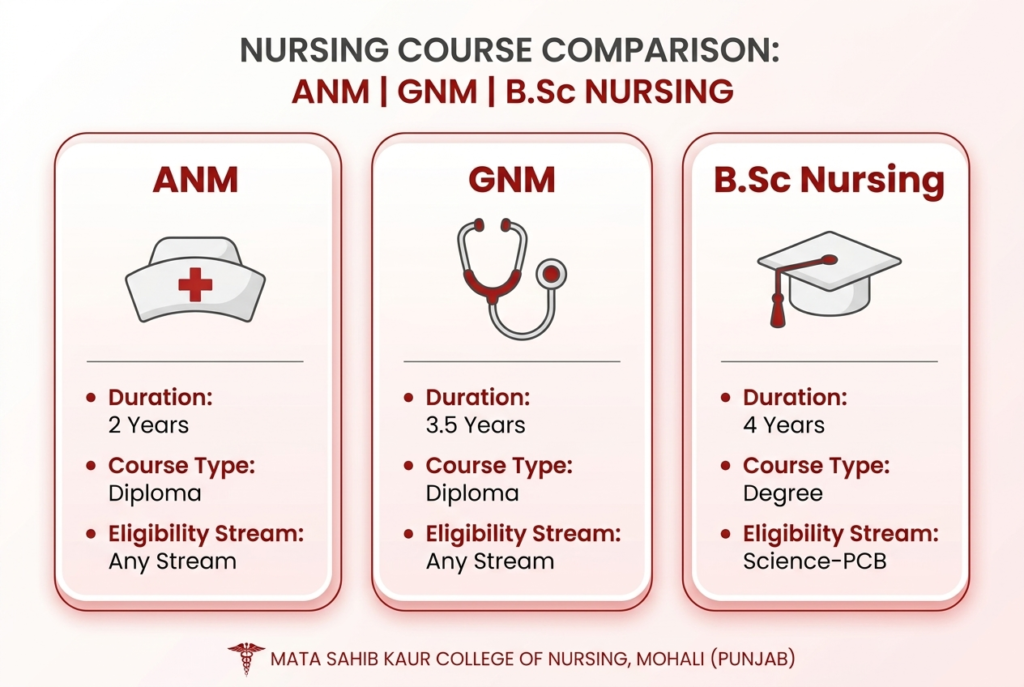
ANM vs GNM vs B.Sc Nursing: Quick Comparison Table
| Feature | ANM | GNM | B.Sc Nursing |
|---|---|---|---|
| Duration | 2 years | 3.5 years | 4 years |
| Eligibility Stream | Any stream | Any stream (Science preferred) | PCB (Science) compulsory |
| Minimum Marks | Pass in 12th | 40–45% | 45–50% in PCB |
| Gender Eligibility | Female only (most states) | Male & Female | Male & Female |
| Course Type | Diploma | Diploma | Degree |
| Entrance Exam | Usually merit-based | Merit-based / minor entrance | State counselling (PNRC/BFUHS) |
| Career Growth | Entry-level, community health | Hospital staff nurse roles | Senior roles, higher studies, abroad opportunities |
| Further Studies | Can upgrade to GNM/B.Sc | Can pursue B.Sc via bridge course | Can pursue M.Sc Nursing, PhD |
There’s no single “best” answer, it depends on your situation. Ask yourself these three question
1. How soon do you want to start earning?
If financial timing matters and you want to start working within 2 years, ANM is the fastest route.
2. Do you want strong hospital-based career options?
If you want to work in hospitals with good long-term prospects and don’t mind studying a bit longer, GNM is a well-balanced choice it’s the most commonly chosen course by nursing aspirants in Punjab.
3. Are you aiming for leadership roles, higher studies, or working abroad?
If your ambition is bigger, becoming a Ward Sister, Nursing Superintendent, pursuing M.Sc Nursing, or applying for international nursing jobs B.Sc Nursing is the investment worth making.
Whichever path you choose, one thing matters most: choosing the right college, one that is PNRC-approved, has proper clinical training tie-ups with hospitals, and genuinely supports students, not just enrolls them.
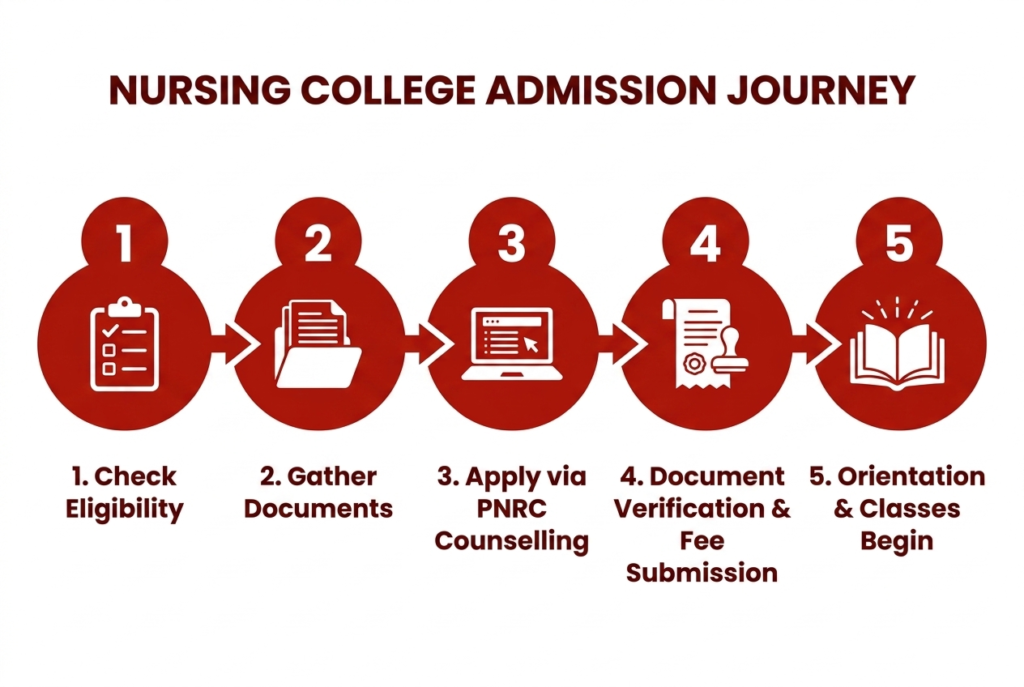
Admission Process at Mata Sahib Kaur College of Nursing
At Mata Sahib Kaur College of Nursing , admissions for ANM, GNM, and B.Sc Nursing programs are now open for the current academic session. Here’s how you can apply:
Step 1: Check Your Eligibility
Confirm you meet the marks, stream, and age criteria for your chosen course (ANM/GNM/B.Sc Nursing) as outlined above.
Step 2: Gather Required Documents
- 10th and 12th marksheet & certificate
- Transfer certificate & migration certificate
- Category certificate (if applicable)
- Aadhar card and passport-size photographs
- Character certificate from last attended institution
Step 3: Apply Through PNRC Counselling / Direct College Admission
Depending on the course, admission is processed either through the PNRC (Punjab Nurses Registration Council) centralized counselling at admission.pnrconline.in , or directly through the college admission cell our counselors will guide you on exactly which process applies to your chosen course.
Step 4: Document Verification & Fee Submission
Once your seat is confirmed, complete document verification at the college and submit the admission fee to lock your seat.
Step 5: Orientation & Classes Begin
New students go through an orientation session covering hostel facilities, clinical postings, uniform requirements, and academic schedules before regular classes start.
Need help with your admission?
Our admission counselors are available to guide you through eligibility, document checklists, and the PNRC counselling process personally reach out today to secure your seat before the admission window closes.
Choosing between ANM, GNM, and B.Sc Nursing isn’t about picking the “hardest” or “easiest” option, it’s about picking the course that matches where you want to be in the next 5–10 years. All three paths lead to a respected, secure, and meaningful career. The only decision left is: how big do you want to dream, and how soon do you want to start?
If you’re still unsure, our counselors at Mata Sahib Kaur College of Nursing are happy to guide you personally based on your marks, interests, and career goals because your first step into nursing should be the right one.
Frequently Asked Questions
Q1. What is the main difference between ANM, GNM, and B.Sc Nursing?
ANM is a 2-year diploma focused on basic and community healthcare, GNM is a 3.5-year diploma with deeper hospital-based clinical training, and B.Sc Nursing is a 4-year degree offering the widest scope for career growth, higher studies, and international opportunities.
Q2. Which nursing course is best for girls after 12th?
It depends on individual goals. Girls who want to start working quickly often prefer ANM, those who want solid hospital career options choose GNM, and those aiming for leadership roles or studying abroad typically choose B.Sc Nursing.
Q3. Can I do B.Sc Nursing without Biology in 12th?
No. B.Sc Nursing requires Physics, Chemistry, Biology, and English as compulsory subjects in 12th. ANM and GNM, however, accept students from any stream in most institutions.
Q4. Is entrance exam compulsory for nursing admission in Punjab?
For B.Sc Nursing, admission is generally processed through PNRC/BFUHS state-level counselling. ANM and GNM admissions are often merit-based, though this can vary by institution; it’s best to confirm directly with the college.
Q5. Can I upgrade from ANM to GNM or B.Sc Nursing later?
Yes. ANM graduates can pursue GNM after gaining some experience, and GNM nurses can pursue B.Sc Nursing through a recognized bridge/post-basic program, allowing you to grow your qualification step by step.